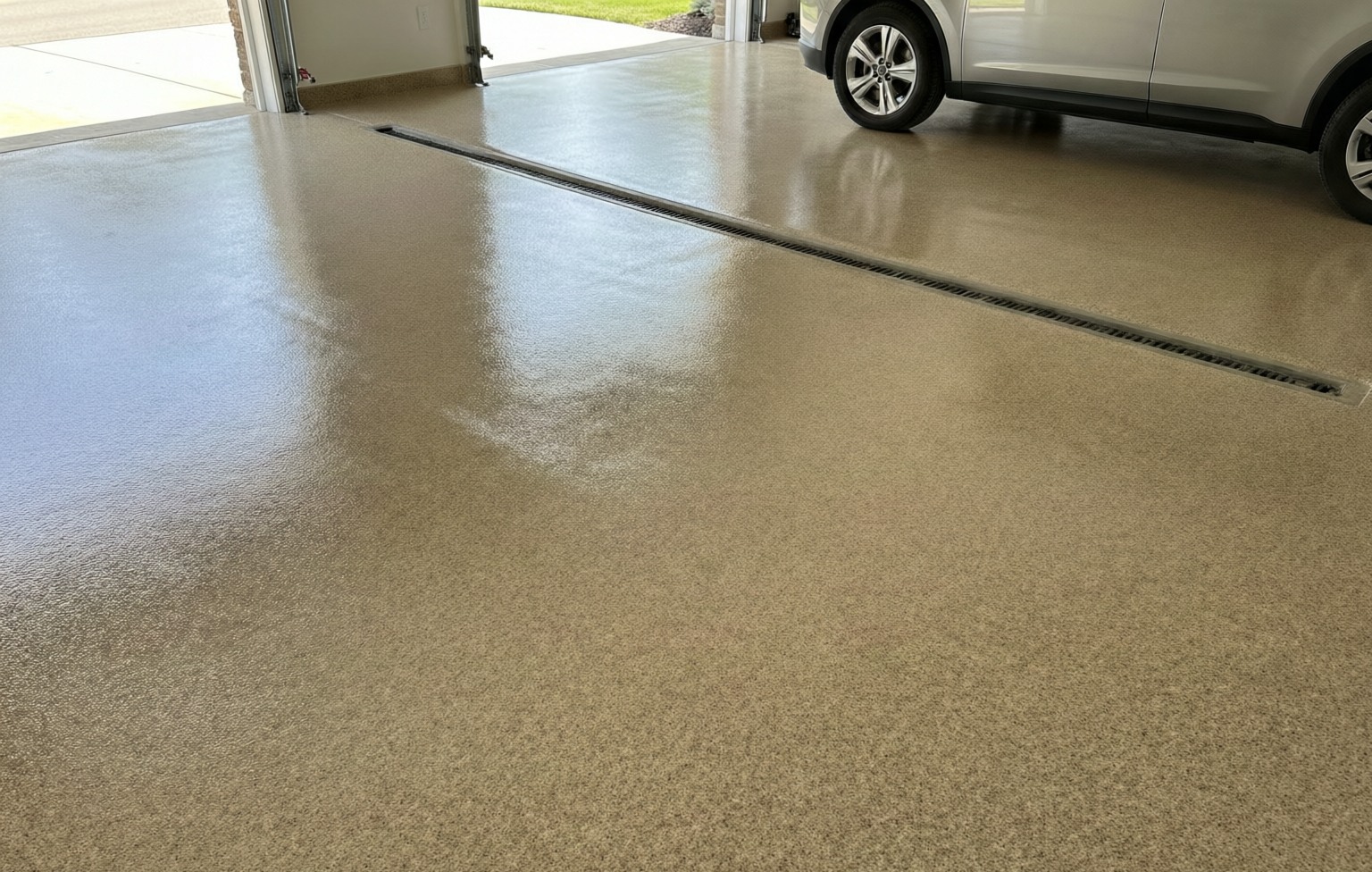
Finished full-broadcast epoxy floor in a residential garage

Epoxy Flooring Cost per m² — How It Is Actually Calculated

Every supplier will give you a number. Almost none will show you how they got it. This page publishes the quantities, the layers they belong to and the eight variables that move the total — then leaves the price to you, because your freight, duty and labour are not ours to guess.

2.5–5.3kg/m² material by system
25 kgstandard export set
16+Years manufacturing
40+Countries exported

Material is one of four cost lines on a resin floor, and it is usually a small one. The other three — substrate preparation, details and labour — are set by your building, not by our price list. So instead of a per-square-metre figure that would be wrong for most readers, here is the part we can state precisely: how much material your floor actually consumes, layer by layer.

Quantity & order calculator

This calculates material quantity and order size. It does not quote a price. If you want a cost, type your own landed rate per kilogram into the last box — that is the only number in the equation that belongs to your market.

Material per m²4.45 kg
Total material979 kg
Sets to order40 × 25 kg
Pallets2 pallets
20 ft share10 % of a 20 ft
40 HQ share5 % of a 40 HQ
Material cost—

Set size 25 kg · 20 sets (500 kg net) per 1200 × 1000 mm pallet, stretch-wrapped with corner boards

Send these numbers on WhatsApp

Quantities are our published build-ups, measured on a ground, profiled slab at the stated nominal thickness. Porosity, profile, ambient temperature and applicator method all move them — budget the overage, and on a variable slab run a 10 m² trial bay before committing to a full container.

Material consumption by system

These are the calculator's planning rates per system, in one table; the layer-by-layer build-up for a specific product is published on that product's page. Per-layer numbers matter: a quote that omits the wear coat is not cheaper, it is incomplete.

SystemNominal buildPrimerMain layerWear coatTotal kg/m²
Solid Colour Epoxy Coloured Sand2 mm0.202.00–2.500.302.50–3.00
Metallic Epoxy Coloured Sand3 mm0.20–0.303.50–4.500.40–0.504.10–5.30
Flake / Quartz Full Broadcast4 mm0.303.60–4.000.60–0.804.50–5.10
Heavy-Duty Garage Broadcast4 mm0.30–0.403.50–4.000.30–0.404.10–4.80
Epoxy Self-Levelling Toppingper mm (2 mm shown)0.302.0 per mm0.304.60 at 2 mm
Antistatic / ESD Self-Levellingper mm (2 mm shown)0.302.2 per mm0.305.00 at 2 mm
Cementitious Levelling Compoundper mm (2 mm shown)0.201.7 per mm—3.60 at 2 mm

The calculator plans at the midpoint of each published range.

The eight things that actually move the number

What is already on the slab

A cure-and-seal, an old adhesive or a failing epoxy has to be ground out before anything goes down. On a 500 m² warehouse that single line can be worth more than the entire material order — and it is the line most quotes leave out.

Slab profile and porosity

Primer consumption is a surface-area number, not a floor-area one. A coarse grind (CSP 4–5) or a porous screed can take 0.45 kg/m² where a fine profile takes 0.25 — a 40 % swing on the layer that carries the least material.

Flatness of the existing floor

Self-levelling is specified by millimetres, so an out-of-level slab is paid for twice: once to level it and once again in topping. Measure with a straightedge before you compare two quotes.

Substrate moisture

A slab over 4 % CM needs a moisture-tolerant primer, and a slab with no damp-proof membrane below grade may need a different system altogether. Testing first is cheaper than a recall.

Details, not areas

Coved wall bases, drain frames, threshold strips, penetration collars and stair nosings are all labour-priced per linear metre. A hospital ward is mostly perimeter; an open warehouse is mostly field.

Environment during the cure

Heating a cold garage, running dehumidifiers through a rainy week, or working nights to keep a plant running are all real costs that a per-square-metre rate hides.

Colour and build tolerance

Metallic effects need a skilled applicator and a controlled room; dark floors show tyre scrub and grit; a matte topcoat costs more than gloss. Same square metres, different labour.

Freight, duty and local resin price

For an imported order this line usually moves the total second only to labour. Landed cost per kilogram is the number to compare suppliers on — not a per-square-metre figure quoted across two currencies.

Ordering wholesale: sets, pallets and containers

Distributors buy by the pallet and land by the container, so that is the data we publish. All three configurations ship from Dongguan, Guangdong, China, stretch-wrapped with corner boards, FOB or CIF Shenzhen or Guangzhou.

Set configurationNet / setSets per pallet20 ft40 HQShelf life
Part A 20 kg + Part B 5 kg (25 kg/set, two pails)25 kg20≈ 400 sets≈ 800 sets12 months
Part A 15 kg + Part B 5 kg (20 kg/set, two pails)20 kg24≈ 480 sets≈ 960 sets12 months
Powder 20 kg (kraft valve bag) + liquid 5 kg pail (25 kg/set)25 kg40≈ 800 sets≈ 1000 sets6 months

Lead time

Order quantityLead timeNotes
Sample (≤ 2 sets)2–4 dayscourier freight collect via DHL / UPS / FedEx, shipping at your cost; 5–7 days door to door
1–49 sets5–7 daysStock colours first; standard export packing included
50–199 sets10–12 daysIncludes batch mixing and in-house QC record per batch
200–999 sets15–20 daysProduction slot reserved after 30% deposit
FCL / 1000+ sets22–28 daysConfirmed against the shipping schedule; FOB Shenzhen or Guangzhou

Own-brand & customisation

  • Colour matchingMOQ 5 sets

    RAL / Pantone reference or a physical sample; we send a wet film for approval before batch production.

  • Own-brand labellingMOQ 20 sets

    Your logo and language on the pails and carton; artwork in AI/PDF. Blank labelling available below this MOQ.

  • Packaging & cartonMOQ 50 sets

    Pail size, carton printing, palletising and shipping marks per your export requirement.

  • Full OEM / ODMMOQ 200 sets

    Formulation adjustment (gloss, cure speed, aggregate, conductivity range) with TDS and CoA issued under your brand.

What we will not quote you

A factory that will sell you anything is a factory that will ship you the wrong thing. These are outside our plant's capability or outside what the chemistry can carry, and we would rather lose the order than fill it badly.

Where a job needs one of these, we say so at quotation stage and tell you what to ask the other supplier for. That has kept us more containers than it has cost us.

Questions buyers actually ask

What does epoxy flooring cost per square metre?

We do not publish a per-square-metre price, and you should be sceptical of any supplier who does without seeing your slab. Material is only one of four cost lines, and the honest number for yours depends on the system, the build thickness, what is currently on the floor and your local labour rate. What we can publish is the quantity: 2.5–5.3 kg/m² of material for a full coloured-sand or broadcast system, and 1.7–2.2 kg/m² per millimetre for a levelling or topping build. Multiply that by your own landed rate and you have a defensible material cost.

How many kilograms of epoxy per square metre?

Primer 0.2–0.4 kg/m² depending on how open the ground profile is, the main layer 2.0–4.5 kg/m² for a coloured-sand or full-broadcast build, and the wear coat 0.3–0.8 kg/m². For a levelling or topping build the rate is per millimetre of nominal build, which is why two quotes for the same room can differ by 30 % — they are not specifying the same thickness.

Why do two quotes for the same floor differ by three times?

Almost always because one of them is not including the same work. The usual gaps are: mechanical grinding versus sweep-prepping, crack and joint repair as a line item or as an assumption, the number of coats, whether the perimeter cove is included, and how many days of access and downtime the applicator has allowed for. Compare scope line by line, not the bottom number.

Is epoxy cheaper than tiles for a large area?

On material per square metre, often roughly the same. The difference is everywhere else: no adhesive bed, no grout, no cutting waste on an irregular slab, no joints for water and bacteria to live in, and no lifting of a tile edge under a wheeled load. On a renovation over existing tiles a resin build-up also avoids demolition and disposal, which is the line that usually decides a tiling quote. Where tiles win is on a badly out-of-level floor you would rather shim than fill.

Does doubling the thickness double the cost?

Not for a broadcast system — the aggregate layer dominates the mass and it is bought by weight, so a 4 mm build is not twice a 2 mm build. For a self-levelling topping it is close to linear, because you are paying for resin by the millimetre. That is why we state consumption per layer rather than a single figure.

Can you send a price list?

No, and deliberately so — a list would be wrong for almost every buyer on it, since our sets are quoted ex-works in Dongguan and your landed cost turns on freight, duty and the formulation you need. What we do send within 24 hours is a line-itemed proforma: system, consumption per layer, number of sets, pallet configuration, net and gross weight, and the FOB or CIF basis you ask for. That is comparable against a competitor's number; a price list is not.

What do you need from me to quote?

Floor area and a photo of the slab, whether it is new or old and what is currently on it, the service the floor will see (vehicle type, wheel material, chemicals by category, wash-down frequency), your country and nearest port, and colour preference. If you have a moisture reading include it; if you do not, say so and we will tell you how to take one.

What is the minimum order, and can I get samples?

A single set is available as a sample, and cured colour chips of your shortlisted systems are free of charge. The courier is not: courier freight collect via DHL / UPS / FedEx, shipping at your cost — we do not prepay or reimburse sample shipping. Custom colour matching starts at 5 sets, own-brand labelling at 20, packaging changes at 50 and full OEM with your brand on the TDS at 200. Small retail kits with a roller in the carton are not something we make — we supply systems sized by area for contractors and distributors.

How much fits in a container?

It depends on the pail size, so we publish the pallet rather than a single container number: 1,200 × 1000 mm pallets, stretch-wrapped with corner boards, 20 sets for a 25 kg coloured-sand set, 24 for a 20 kg self-levelling set and 40 bags for the cementitious powder. A 20 ft holds about 20 pallets and a 40 HQ about 40, weight permitting. Tell us your set size and we will confirm the loading against the shipping schedule.

What will you not quote us?

Polyaspartic and polyurea topcoats, PU cement mortar, epoxy terrazzo, microcement and small retail DIY kits — we do not make them, so we say so rather than source someone else's drum and label it. Same for duty we cannot meet: steel-wheel traffic, sub-zero service, steam cleaning, standing concentrated reagents, and radon mitigation. If your project needs one of those, the honest answer is a different supplier, and we will tell you at quotation stage rather than after handover.

Get a Free Quote

Get a line-itemed proforma instead of a price list

Send the area, a photo of the slab and the service the floor will see. We reply within 24 hours with system, consumption per layer, set count, pallet configuration and the FOB or CIF basis — numbers you can actually compare against another supplier.

  1. Tell us about the floorArea in m², substrate condition, and the finish or colour you want.
  2. Get a technician's replyWithin 24 hours: system build-up, coverage estimate, pricing and TDS/MSDS.
  3. Confirm colour & sampleFree colour chips and a cured sample panel before you place an order.

* Required fields. Your information is only used to respond to your inquiry.

Request a Quote

We reply within 24 hours

* Required fields. Your information is only used to respond to your inquiry.