
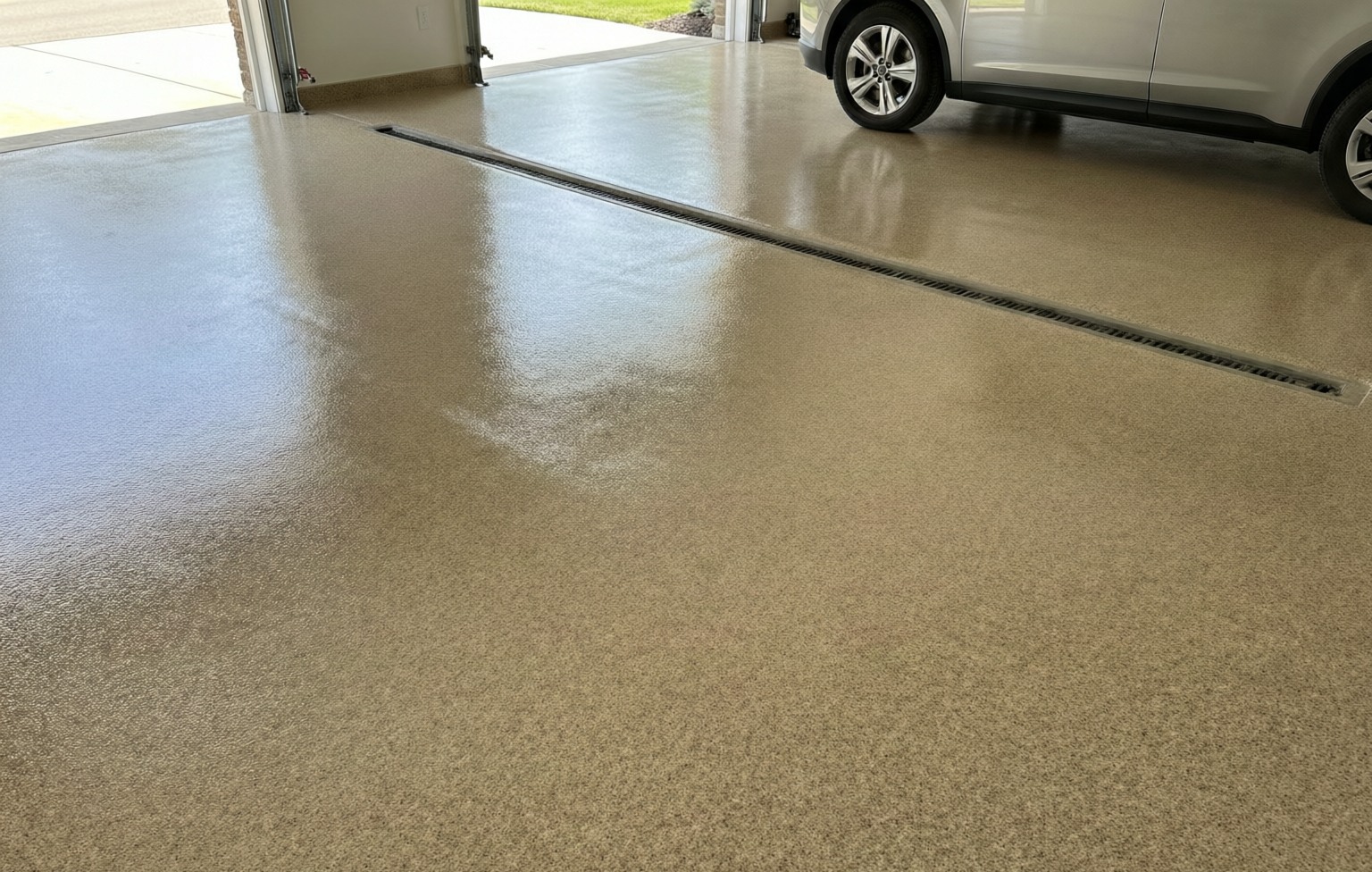
Why coat your garage floor?
A coated garage floor resists oil, fuel and tyre marks, stops dust, and is far easier to clean than bare concrete.
The dust point is the one people underestimate. A garage slab is bare concrete, abraded by traffic every day, and it generates dust continuously — that dust is what ends up on every tool, every paint can and the top of every car. A sealed film stops the generation at source rather than cleaning up after it.
Oil is the other half of the argument. Bare concrete accepts oil and then gives it back — a stain that reappears after every wash is oil leaving the slab, not new spillage on it. A seamless film keeps the spill on the surface, where a cloth can reach it.
Preparation is everything
Diamond-grind or shot-blast the slab, repair cracks, and ensure it is dry. Good prep is what makes the 3.8 MPa bond possible.
Preparation is also the step that gets cut, and it is the one that decides everything after it. Grinding removes laitance, old sealer and any curing membrane; without that, the resin bonds to a weak skin and lifts with it still attached underneath. Acid etching is not an equivalent — it changes the surface chemistry and leaves the residue smeared rather than opened.
Old oil is a preparation problem, not a cleaning problem. Years of soaked-in oil will not wash out, and it will walk back through a new floor as a dark map of whatever the slab absorbed. The affected area is milled out or removed; that is cheaper than discovering it in month two.
Choose the right system
For garages we recommend a heavy-duty anti-slip epoxy colored sand that resists hot-tyre pickup and abrasion.
Texture belongs in the wear layer, not in a topcoat applied over a smooth floor. A broadcast or flake build with aggregate in the body keeps its grip after months of driving on it, whereas grip that lives only in a thin surface coat is the first thing a tyre removes.
Two other briefs look like a garage floor but are not one. An antistatic or ESD floor is a conductivity requirement with its own build-up and its own earth bonding detail. A metallic floor is a visual requirement with a much tighter tolerance on slab flatness and on how fast the crew can work. Both of those are their own product pages, and the numbers there are not the numbers for a garage.
Curing & return to service
Walk on in about 8–12 hours, and a car can be rolled on at around 24 hours at 20 °C. Rolling is not parking: a hot tyre left standing on the film needs it fully cured, so let it reach day 7 before the car sleeps in the garage. An unheated garage at 10 °C roughly doubles every one of those times.
The cold-garage case is where most disappointment comes from, and it is not linear: below the working band printed on the product page the cure stalls rather than merely slowing, so a January pour in an unheated single-skinned garage can sit soft for days longer than the table suggests.
The other cold-slab trap is dew. If the surface temperature falls to the dew point while the film is still wet, moisture condenses into it and the finish blushes — a whitening under the surface that cannot be polished out, because it is not on the floor, it is in it.
Maintenance
Sweep regularly and mop with a neutral cleaner — the seamless surface wipes clean instantly.
Neutral means pH-balanced, not concentrated. A degreaser left to sit on a gloss film attacks the gloss before it attacks the grease, so dilute it, keep the contact time short and rinse. Fuel and brake dust are worth hosing off within days rather than at the next wash — they are the two things that soften a coating from above.
The details people forget to plan
Four items cost nothing to decide before the pour and are expensive afterwards. Door undercuts and thresholds: a build-up of a few millimetres means a door that just cleared before may not clear after. Falls and drainage: a wash-down bay needs water to reach a channel, and a smooth film will not carry it there by itself. Edges: a coved detail where floor meets wall is what keeps a mopping edge from becoming a dirt line, and it has to be built while the floor is wet. And the first week: a board or mat under the tyre positions while the film reaches full cure, because a hot tyre left standing is what deforms a film that has not cross-linked yet.
The garage-specific builds are anti-slip coloured sand and flake; for ramps and decks see the broadcast ramp system. Cure, load and thickness figures for each are on its own page.