
How long until I can walk on the floor?
About 8 hours for foot traffic; light service from 24 hours, and full cure at 7 days at 20 °C before heavy traffic or chemical exposure.
Questions buyers actually ask, answered by the people who mix the batch. The numbers behind them come from the same tables our quotations use.
About 8 hours for foot traffic; light service from 24 hours, and full cure at 7 days at 20 °C before heavy traffic or chemical exposure.
Full cure at 7 days at 20 °C is the general rule, and several builds are stricter than that: a garage or warehouse system that will see pallet trucks or hot tyres has its own lighter-load and full-load timings printed on that product page. Early entry does not just scratch a floor, it leaves permanent deformation in a film that has not cross-linked yet, so we would rather you wait than trust a calendar.
Yes, and not proportionally. Below the temperature band printed on the product page the cure stalls instead of merely slowing, and a slab sitting below the dew point will blush the surface while it is still wet. Tell us the season, the room temperature and whether the building is heated before we schedule a batch — the same material behaves differently in a January shed and a July warehouse.
Gentle warmth in the slab is the useful direction; a fan aimed at a fresh pour is not. Air movement across a wet film pulls heat out of the surface faster than the body of the coating cures, which is how you get a skin that reads dry on top and stays soft underneath — and a hard skin over a soft film is exactly what wheels and point loads dent.
Sound, dry and mechanically abraded. Diamond grinding opens the pore structure and removes laitance, old sealer and any curing membrane; acid etching is not a substitute, because it leaves the surface chemically altered and still smeared. Resin bonded to contamination lifts in sheets, and that failure shows up weeks later under your customer rather than on the day.
A reading. New concrete is normally left to cure for weeks before a resin goes on it, but the number that gates the pour is a moisture measurement taken through the slab, not the age of the pour; a slab that was sheeted with plastic can read compliant while still holding water. Where the slab sits on grade without a working damp-proof membrane we treat it as something to measure rather than assume.
Often yes, over sound, well-bonded ceramic, quarry, porcelain or most vinyl, once the glaze is abraded and the surface degreased. What it will not do is rescue a hollow or debonded tile, or bond to foam-backed adhesive, so those come up first. Expect a build-up of a few millimetres, which means door undercuts and thresholds get planned before you order — and in a building of a certain age the tile adhesive itself wants a survey before anyone grinds it.
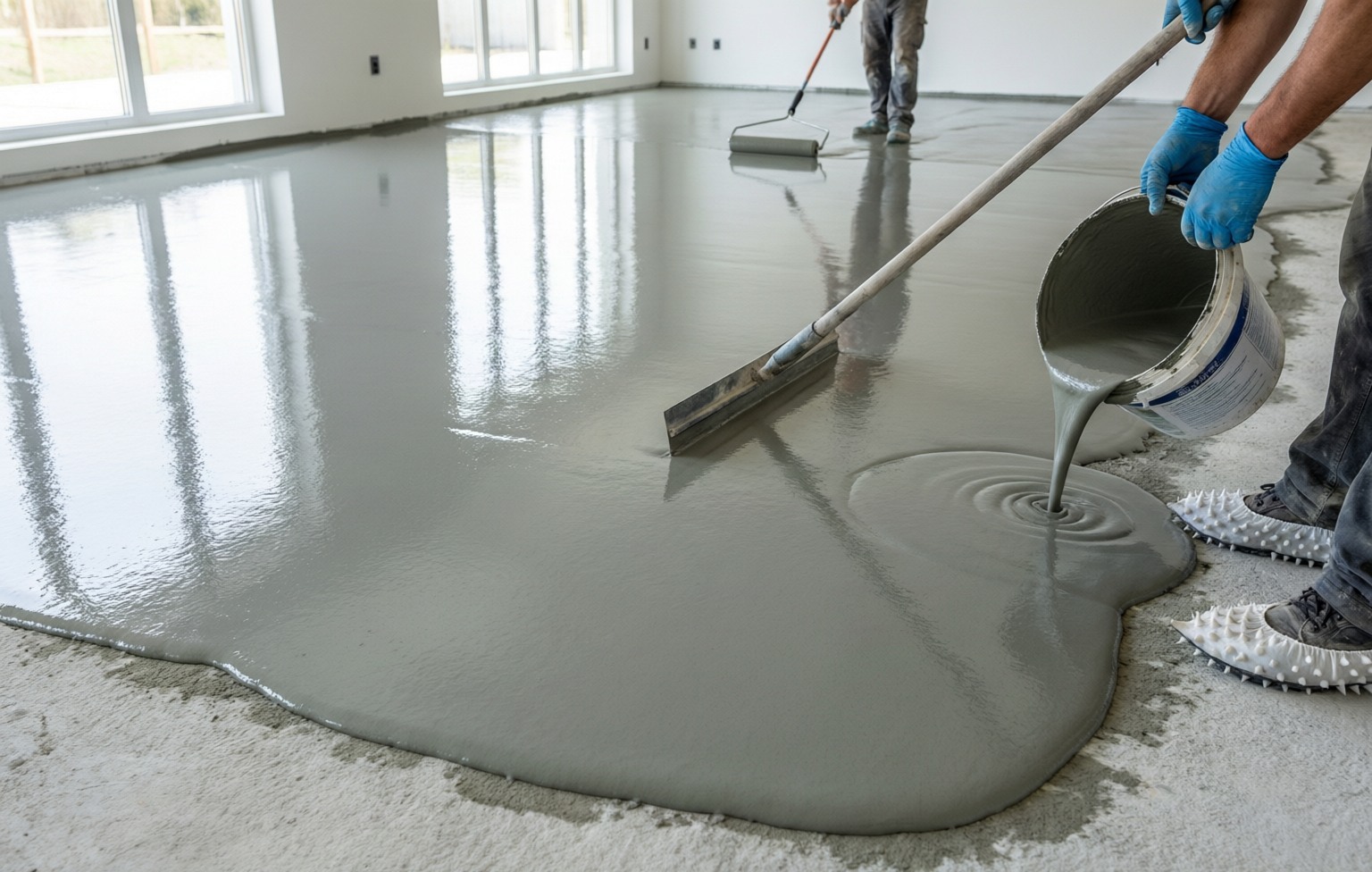
Our flexible UV-resistant self-leveling epoxy is designed for heated and sunlit floors.
It is a two-part, metered resin system, and the unforgiving part is timing rather than strength: the mix ratio is weighed, the open time decides how much area you can close in one pass, and a broadcast has to go in while the bed is still wet. A mistake is not a patch, it is a grind-out. We supply material and build-up; contractors install it — and a buyer who has never laid one should order a trial set before a container.
Slip behaviour here is a texture decision, not a certificate. A fine aggregate or a salt-and-pepper build reads smooth under dry shoes and stays underfoot-satisfactory when damp, while a graded or full broadcast is what a wash-down bay, a ramp or an open deck wants. We specify texture by how the floor will actually get wet rather than by quoting a rating we have not tested ourselves.
Be precise about what a UV-stable topcoat buys. A standard clear epoxy will amber under direct sunlight — that is chemistry, not a quality defect — and a UV-stable wear coat resists that movement. Neither makes a colour permanent under UV, so a floor in a sunlit atrium should be specified with that trade in mind rather than promised something else.
Yes, and honestly: visibly. The workable repair runs to a planned line — a bay, a joint, a change of room — rather than blending around a scuff, because a seamless film has no grout line to hide a repair edge behind. Where the room is prominent, keep material from the same pigment lot.
A reflective build reports on the slab beneath it. Ridges of laitance, a patched corner, a joint filled and never levelled — all of it reads through gloss under ceiling lighting, and a mirror finish also shows every footprint until the room walks it in. That is why preparation here is a grinding step rather than a cleaning step, and why the flatness you get is mostly the flatness you handed over.
Yes — where a build publishes a VOC figure it sits between 2 and 8 g/L, the cementitious levelling compound at the low end and the garage broadcast at the high end, and the indoor builds that carry an emission classification show French A+. Most odour is released during application and for the first day after, and ventilation is what clears it; walk-on is a same-day event, but light service starts at 24 hours and full cure at 7 days.
It means the solvent load is low, not that the room is smell-free. Most odour leaves during application and the first day afterwards, and cross-ventilation clears it far faster than any formulation change, so schedule the pour around the ability to open the building. Do not read a quiet nose as permission to load the floor — that is a cure clock, not a smell clock.
The document list on this page says what can go into the shipping file, from the technical data sheet and per-component safety data sheet through to a batch certificate of analysis and a declaration of conformity for European projects. Anything beyond that is a question to ask, not a promise to assume: if a document does not exist we will say so rather than issue something vague to fill the gap.
Not where we cannot show a test report against that specific standard. A floor can be described by what is measured without implying a certification nobody issued, and a buyer who checks will notice the difference. Where a classification does exist for a given build — an indoor emission class, for instance — it is named on that product page.
Yes. We support custom RAL colours, private-label packaging and OEM/ODM orders.
Yes, and it is the normal first step — the lead-time table on this page is where the timing actually comes from. What we ask for in return is a photo of the substrate and the target thickness, because a sample of the wrong build tells you very little about the floor you are buying.
No, deliberately. Our sets are quoted ex-works in Dongguan or FOB/CIF to your port, and a printed per-square-metre rate would be wrong for almost every buyer who read it, since it silently assumes your freight, duty, slab and labour. What we do publish is the quantity — consumption per layer — so your own landed rate can be turned into a defensible number on the cost page.
Almost always because they are not specifying the same build. Design thickness, how much aggregate sits in the wear layer, whether priming is one pass or two, and what the slab needed first all move the mass of material, and the mass is what costs money. Ask for the layer-by-layer quantity and a comparison becomes possible.
Up to 10 years on epoxy systems when installed per our guidelines.
Stock colours ship first; batch production starts when the deposit lands. The same ladder the sales team quotes from.
| Order quantity | Lead time | Notes |
|---|---|---|
| Sample (≤ 2 sets) | 2–4 days | courier freight collect via DHL / UPS / FedEx, shipping at your cost; 5–7 days door to door |
| 1–49 sets | 5–7 days | Stock colours first; standard export packing included |
| 50–199 sets | 10–12 days | Includes batch mixing and in-house QC record per batch |
| 200–999 sets | 15–20 days | Production slot reserved after 30% deposit |
| FCL / 1000+ sets | 22–28 days | Confirmed against the shipping schedule; FOB Shenzhen or Guangzhou |
5 sets
RAL / Pantone reference or a physical sample; we send a wet film for approval before batch production.
20 sets
Your logo and language on the pails and carton; artwork in AI/PDF. Blank labelling available below this MOQ.
50 sets
Pail size, carton printing, palletising and shipping marks per your export requirement.
200 sets
Formulation adjustment (gloss, cure speed, aggregate, conductivity range) with TDS and CoA issued under your brand.
Two-pail kits, palletised and corner-boarded. Your freight forwarder needs the pallet footprint and net weight per pallet, so both are given rather than a single carton figure.
| System | Kit composition | Pallet | Container | Shelf life |
|---|---|---|---|---|
| Coloured sand | Part A 20 kg + Part B 5 kg (25 kg/set, two pails) | 20 sets (500 kg net) per 1200 × 1000 mm pallet, stretch-wrapped with corner boards | 400 sets / 20 ft · 800 sets / 40HQ | 12 months |
| Self-levelling | Part A 15 kg + Part B 5 kg (20 kg/set, two pails) | 24 sets (480 kg net) per 1200 × 1000 mm pallet, stretch-wrapped with corner boards | 480 sets / 20 ft · 960 sets / 40HQ | 12 months |
| Cementitious | Powder 20 kg (kraft valve bag) + liquid 5 kg pail (25 kg/set) | 40 bags (1,000 kg net) per 1200 × 1000 mm pallet, shrink-wrapped, liquid pails interleaved | 800 sets / 20 ft · 1000 sets / 40HQ | 6 months |
Issued to the factory as a supplier. A test report or an emission class that belongs to one specific formulation is named on that product page instead — not here.
Quality management system for the flooring coatings line
Certificate copy + audit scope on request
Adhesion, hardness, abrasion and VOC on finished film
Test report per batch on request
Declaration of conformity for European projects
DoC issued with shipment documents
Indoor air-emission class for living-space floors
Classification sheet on request
Product liability cover for exported goods
Policy summary on request
Per component — needed for sea and air freight approval
Issued with every shipment
Send the room photo, the slab age and what the floor has to take — we answer with the build-up, not a brochure.