
Quick answer
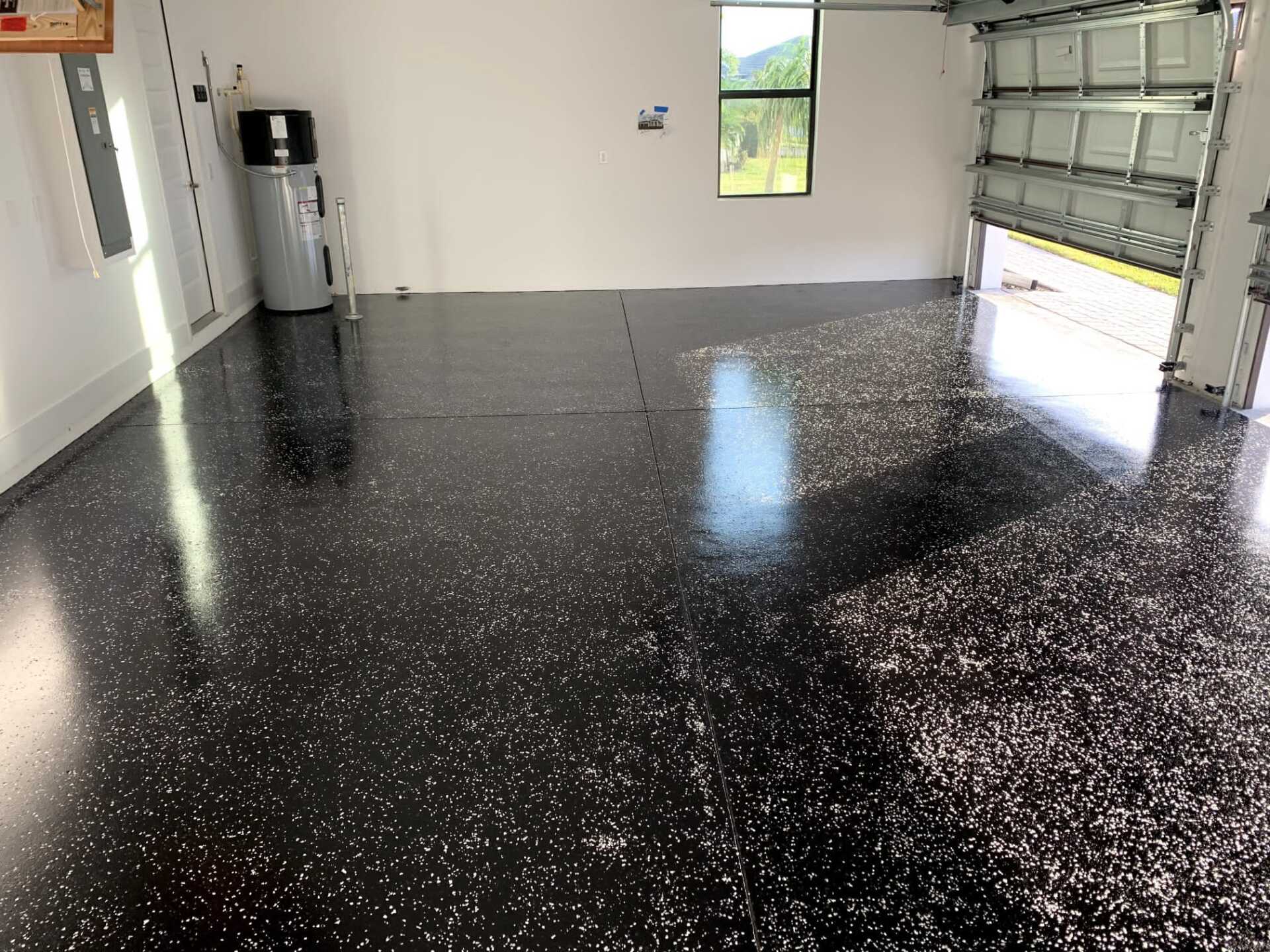
Choose epoxy colored sand for decorative, slip-resistant, textured floors (garages, showrooms, homes). Choose self-leveling epoxy when you need a perfectly flat, glass-smooth, hygienic surface (cleanrooms, labs, hospitals).
Both are two-part epoxy, both are seamless, and both go down at a few millimetres. So this is not a question of which material is better: it is a question of what the room has to do, and what the floor will be walked over every day.
Appearance
Colored sand offers metallic, solid and flake looks with subtle texture. Self-leveling gives a mirror-flat, high-gloss seamless finish.
Texture hides, gloss reports. A textured build breaks up footprints and scatters the light instead of reflecting it back, so a slab with ridges of laitance, a patched corner or a filled joint stays readable rather than becoming a mirror of those defects. That is a specification decision, not a quality one — but it is the one buyers most often regret getting backwards.
Thickness & build
Colored sand is typically 2–4mm broadcast; self-leveling is poured at 1–3mm and flows flat on its own.
Read the layer table rather than the headline number. A build described as three millimetres that puts most of that depth into broadcast aggregate is a different floor — and a different mass of resin — from three millimetres of self-levelling compound. Two quotations at the same thickness can differ substantially in material, and the material is what you pay for.
Cost & speed
Both go down fast compared with a traditional screed, because there is no drying wait between the levelling layer and the wearing floor. Self-leveling is often the quicker install on large open slabs.
A broadcast is slower per square metre because the aggregate has to be thrown into a wet bed and the surface then consolidated, and because the next layer is timing-critical. On a big, flat, open slab the self-levelling option wins on labour hours; on a slab with defects to hide, the extra mass of a textured build is what buys the finish.
Where the money actually goes, in order: what the slab needs first, then priming, then the wear layer. Our cost page publishes consumption per layer and sets per pallet so you can price all three at your own landed rate.
Which should you pick?
Match the system to the room: durability and grip for working spaces, flatness and hygiene for controlled environments.
Split it where the building does. A loading bay, a ramp and a wash-down area want texture and mass; a cleanroom, a lab or a clinical area wants a flat, joint-free surface that can be wiped. The two systems share a preparation logic, so many projects specify both — see the garage and cleanroom groupings, or the healthcare page for the clinical case.
Can they be combined on one floor?
Yes, and it is common: broadcast in the areas that take traffic and impact, a flat self-levelling wear coat where hygiene and cleanability decide it. Two things need planning rather than permission. The first is the joint between the two finishes — a textured build has a physically rough edge, so the change should land on a planned line such as a doorway or a bay boundary. The second is the recoat window between layers, which is printed per product in its technical specifications; once a coat has gone past it, the surface has to be abraded again before anything goes over it.
Each of the four finishes has its own page: self-levelling epoxy, flake coloured sand, solid-colour sand and metallic.